
Understanding Fairfax County Releases
A Fairfax County release record concerns one stay in custody. It joins the person's identity and booking to the legal cause for confinement, then records the event that ended the Sheriff's custody. That event may put the person in the community. It may also send the person to the Virginia Department of Corrections, another jail, a federal officer, or another lawful custodian. The destination matters as much as the date.
The Fairfax County Adult Detention Center is the principal local adult jail. Its public policy identifies correctional status and release date as information that may be shared unless a safety or investigative reason requires suppression. Correctional status can include in confinement, probation, work release, escape, or no longer in custody. That official status is stronger proof than a name disappearing from a web search. Fairfax has no verified public jail roster or released-person feed, so the Sheriff's telephone and records channels are central.
Fairfax County Release Outcomes
The word release covers several legal and physical outcomes. A bond or recognizance release ends the current detention while the case continues. Time served or sentence completion ends confinement on a sentence, provided no other charge, warrant, or detainer holds the person. A dismissal can remove one reason for custody without resolving another case. Work release and electronic incarceration permit movement outside a secure cell but remain court-ordered control.
| Recorded outcome | Meaning | Best next record |
|---|---|---|
| Bond or recognizance | Local detention ends while the case stays open | ADC release transaction and court or magistrate order |
| Time served or completion | The active local term has been met | Sentence, jail-credit record, and final release entry |
| Probation or supervised release | Physical custody ends, but conditions remain | Court order and supervising-agency record |
| Transfer | Fairfax custody ends without community release | Transfer record and receiving-custodian search |
| Parole | A qualifying state prisoner leaves under conditions | Board decision plus VADOC release documents |
A court order supplies authority, but the Sheriff's checks determine when out-processing is complete. Booking staff compare the identity photo, booking jacket, court card, sentence computation, detainers, and warrants. Bond processing also requires the magistrate release card to match the charge, court, date, and signature. A docket entry and the physical departure time can therefore differ.
Fields in Fairfax Release Records
Fairfax Sheriff's SOP 530 names a useful set of public fields. A focused request should tie those fields to the same booking and ask for the existing release transaction rather than asking staff to research a broad history. No public Fairfax data dictionary was found, so any local disposition code should be quoted as produced and matched to its agency definition.
| Field | What it establishes |
|---|---|
| Name and inmate ID | The identity attached to the Fairfax booking |
| Arrest or confinement date | When the recorded custody episode began |
| Charge, bond, and court date | The case and release conditions linked to the stay |
| Correctional status | Whether the record says confined, work release, probation, escape, or no longer in custody |
| Release date and time | When Fairfax processed the exit, if both values are retained |
| Release type or authority | The recorded reason or document supporting the exit |
| Receiving agency | Where custody went next after a transfer, when recorded and releasable |
The release shift log can provide a durable trail for a named booking. A narrow request for the related entry is more practical than asking for a whole day's log, which can contain unrelated information and require redaction. If the record says transfer, ask whether an Inmate Transfer Sheet or receiving-agency field exists.
Request Fairfax County Release Records
The Fairfax County Sheriff's FOIA page is the official request route. Requests may be emailed to sheriff@fairfaxcounty.gov or mailed to the Sheriff's Office FOIA Officer, 4110 Chain Bridge Road, Suite 217, Fairfax, VA 22030. The named officer can change, so use the live page before addressing mail.
- Identify the person with full legal name, birth date, inmate ID if known, and an approximate booking period.
- Ask for the existing correctional-status and release-date fields, release transaction or shift-log entry, recorded type or authority, and receiving agency if recorded.
- Request an electronic copy in an existing format and ask for a cost estimate before charges are incurred.
- If anything is withheld, ask for the legal basis and for all portions that can be separated and released.
- Compare the response with the latest court order and any receiving-custodian record.
The Sheriff may charge its reasonable actual cost. A deposit may be required when an estimate exceeds $200. Under Virginia Code § 2.2-3704, the ordinary response period is five working days, with a possible seven-working-day extension when timely production is not practical. The law governs existing records; it does not require a new report or a legal conclusion.
Inactive administrative files are kept under retention schedules, but no specific public retention term for the Fairfax release transaction was verified. Ask the FOIA officer about the record series. Sealing or expungement can also limit later public access. Fairfax Circuit Court explains that expungement seals public access rather than simply erasing history, and later access requires lawful authority.
Virginia Law on Fairfax Releases
Virginia FOIA controls requests for existing government records. Virginia Code § 2.2-3706 addresses law-enforcement records and adult routine-intake photographs, subject to limits such as a temporary ongoing felony-investigation exception. Public status fields do not make the whole inmate file public. Juvenile, medical, investigative, security-sensitive, sealed, and expunged material can remain restricted.
- Discharge
- The end of a particular sentence, custody term, or supervision obligation, as the responsible agency records it.
- Time served
- A sentence outcome crediting confinement already completed.
- Detainer
- A notice that another authority may have a lawful custody claim.
- Expungement
- A court process that can seal qualifying records from ordinary public access.
Note: A lawful no-record response may reflect a seal, the wrong custodian, or a retention limit rather than proof that no booking existed.
Fairfax Jail Release Scale
The Sheriff's ADC history and facility page reports 16,305 bookings and an average daily population of 666 for fiscal year 2024. Its standards-based maximum capacity is 1,260. These numbers show the scale of local booking work, but none is a count of releases, unique people, or exits during a given day.
Booking totals cannot fill the gap left by the absence of a recent-release feed. One person may have more than one booking, and a transfer is not a community release. Person-specific confirmation still requires the Sheriff's correctional status and release transaction.
When Fairfax Jail Releases Occur
Fairfax SOP 526 documents one scheduled 8:00 a.m. release workflow. Staff prepare remaining medication, check transportation, consider suitable cold-weather clothing, and make an OAR referral where appropriate. The procedure is evidence of a planned release process, not a promise that every person leaves at that hour.
Bond, court, transfer, warrant-clearance, and sentence events can arise on another schedule. A judge may authorize release before staff complete identity checks and clear other holds. Call the ADC on the day in question rather than treating a scheduled workflow as a personal release time.
Getting Home After Fairfax Release
The Sheriff's transportation check does not promise a publicly funded ride. Fairfax Connector Route 610 serves the Judicial Drive at Court House stop 6775 near the Judicial Center. Riders should check the current day and timetable because schedules change.
No official family pickup curb or exterior release door was verified. Public parking is listed at 10550 Page Avenue, Garage B, but a family member should call 703-246-2100 for current instructions. Certain treatment programs may provide immediate transport to continuing care, which is a limited program service rather than a general release ride.
Fairfax Pretrial Release Reviews
Fairfax Court Services interviews confined defendants each day and may recommend personal recognizance, third-party custody, or supervised release. The recommendation first goes to the ADC duty magistrate. If release is not granted there, it can proceed to the 8:30 a.m. prisoner advisement hearing.
This is a local path out of pretrial detention, not a final case disposition. The magistrate or judge provides legal authority, while the Sheriff's record supplies the actual release transaction. Conditions can remain even though the person is no longer in a cell.
Property After Fairfax County Release
Fairfax out-processing includes an inventory and return of stored clothing and controlled personal property. The official sixty-day transfer-property form applies when property cannot accompany a transfer and a designated person may collect it. That rule should not be confused with ordinary community release, when stored items are meant to return through out-processing.
The ADC FAQ says a trust balance is generally mailed seven days after release and directs follow-up if it has not arrived within ten business days. The Sheriff trust-fund procedure adds timing detail. Weekday daytime release may allow cash or a prepared check, while deposited funds after 3:30 p.m., on a weekend, or on a holiday may be mailed after the address is checked. Without a mailing address, a former inmate may be told to return to Post 18 on the next business day. The Property Section is 703-246-4405; trust-account follow-up uses 703-246-2100, option 4 then 4.
Locate Fairfax County Released Inmates
A reliable search follows each custody layer. Fairfax County does not publish a verified current roster, 24-hour release feed, or 72-hour release feed. The absence of a name from an unofficial list cannot establish the event. Begin with the ADC, then use the court and the custodian that may have received the person.
- Call 703-246-2100, press 4, then 1 for inmate information or 2 for bonds, release dates, and court dates. Ask whether the status says no longer in custody and whether the exit was a release or transfer.
- Read Fairfax General District Court records for misdemeanors and felony preliminary matters, or Circuit eCaseSearch for felony judgments and appealed cases.
- Follow a state transfer in VADOC, a federal transfer through BOP, or an immigration custody issue through ICE when the facts support that route.
- Use Virginia Jail VINE for alerts, while treating transfer and release as different events.
- Request the Sheriff's durable release transaction when online and oral sources do not settle the question.
Spelling, aliases, a wrong birth date, data lag, transfer, full discharge, or sealing can all produce a search miss. A negative result describes only what that particular system publishes. For a same-day exit, use the same official fallback chain because no rolling Fairfax release feed was verified.
VADOC Fairfax Release Search
The VADOC Inmate and Supervisee Locator covers people currently under Virginia corrections custody or supervision. It can show a move from an institution to community supervision, which helps distinguish physical prison release from complete discharge. The locator is updated daily and warns that data may be inaccurate or old. It is not proven to be a permanent archive for fully discharged people.
| Search field | Use | Limit |
|---|---|---|
| First and last name | At least the first three letters of the first name and full last name | Aliases and spelling can cause misses |
| Seven-digit DOC ID | Direct state record search | An ADC inmate ID is not automatically a VADOC ID |
| Location | Optional custody or supervision filter | A transfer or update may change it |
| Race, gender, age range | Optional identity refiners | Do not rely on one field alone |
The public result was CAPTCHA-gated during research, so no exact released label or projected-date field was verified. VADOC policy does confirm that staff may provide a projected release date at inquiry. The VADOC facility release process identifies final documents, including the Order of Release or notification-of-release letter, which are stronger proof than a locator disappearance.
The official locator interface illustrates the state search path. View the VADOC locator source before using the form.
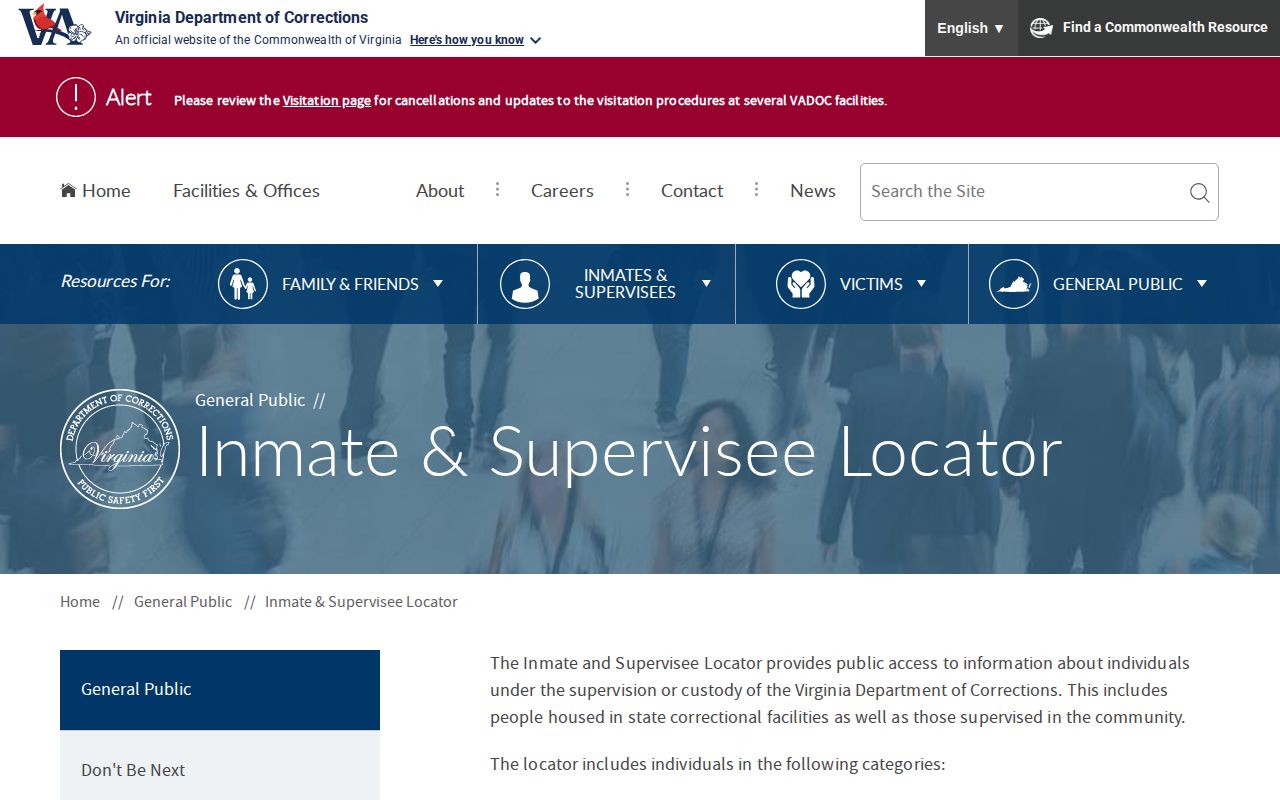
The state screen applies to VADOC custody and supervision, not every short Fairfax jail booking.
Fairfax Release Court Records
Courts preserve legal context that a missing release feed cannot supply. Circuit eCaseSearch is free and continuously available for nonconfidential felony and appeal information. Fairfax General District Court generally retains criminal records for ten years, keeps about three years on site, and may need two to three business days to retrieve older files.
A court record can show bond, disposition, sentence, active and suspended time, jail credit, probation, and later sealing orders. It usually does not show the minute the ADC finished out-processing. Compare what each date means: an order date, a sentence date, a transmitted alert, a projected release date, and the Sheriff's transaction time are different fields.
Fairfax Supervision After Release
The Virginia Parole Board decides parole, while VADOC runs state community supervision. Ordinary discretionary parole is generally unavailable for felony offenses committed on or after January 1, 1995, subject to exceptions. A released Fairfax prisoner should not be called a parolee without the governing record. The person may instead be on probation, post-release supervision, supervised pretrial release, or no supervision.
An active VADOC community-supervision result may identify Fairfax District 29. Fairfax GDC Court Services is a different agency that handles local pretrial supervision and certain probation cases. Read the sentencing or release order to find the right office and distinguish state supervision from a local pretrial condition.
Fairfax Reentry Before Release
Fairfax release planning can start before the exit. Sheriff SOP 225 calls for OAR screening of people nearing community release, generally within sixty days and up to 120 days for case management. The Sheriff's ADC reentry programs describe the local service layer, and a Community Services Board partnership supports continuity for medication-assisted treatment.
That partnership may provide bridge medication and, in some cases, immediate transport to continuing care. Eligibility and current availability must be checked with the program. These supports do not prove a release occurred, but their records can help explain the planned transition and the services arranged at departure.
Fairfax Release Alerts and Transfers
Virginia Jail VINE covers Fairfax local-jail custody changes and supports phone, email, text, TTY, or in-app notices. A transfer alert must not be shortened to community release. State custody uses VADOC's separate NAAVI program for eligible victim notification. Public access to the VADOC locator does not create eligibility for NAAVI.
Federal cases use separate systems. The BOP locator generally covers federal records from 1982 forward and can display a release date or `RELEASED` location, which ends BOP custody but not necessarily supervision or custody elsewhere. ICE's locator covers current detainees and a limited recent-release period. A federal or ICE miss is not proof of an ADC community release.
ICE and Fairfax Jail Release
Fairfax ended its ICE intergovernmental service agreement in 2018. Current Sheriff policy does not keep a person beyond the fixed lawful local release time solely because of an administrative immigration detainer. A judicial immigration warrant can authorize continued custody and a handoff.
That distinction changes the record. A judicially authorized transfer to ICE ends the ADC booking but does not place the person in the community. Ask Fairfax for the receiving-agency field or transfer document, then check the separate ICE custody layer. Removal, ICE release, local release, and transfer are not interchangeable terms.
Compare Fairfax Release Sources
Each system answers a different part of the custody question. Use the source tied to the agency and the time period involved.
| Source | Best use | Key limit |
|---|---|---|
| ADC telephone and Sheriff record | Fairfax correctional status, release date, bond routing, or transfer | Later custody belongs to the receiving agency |
| Fairfax courts | Order, disposition, sentence, credit, and probation terms | Usually not the physical exit time |
| Virginia Jail VINE | Local custody-change notice | A notice can reflect transfer |
| VADOC locator and records | State custody or active supervision | Not every local detainee enters VADOC |
| BOP or ICE locator | Relevant federal custody layer | Neither is a general Fairfax release search |
Note: Preserve the source's event label and timestamp before reconciling a conflict between the jail, court, alert, and receiving system.
Fairfax County Release Facilities
Fairfax County Adult Detention Center is the main local adult jail. A person may leave for the community after bond, recognizance, time served, sentence completion, or another order, but may instead transfer to VADOC, another jurisdiction, a federal officer, or ICE under valid judicial process.
Alternative Incarceration Branch supports Work Release, Community Labor Force placements, and Electronic Incarceration from its connected minimum-security setting. Time outside the building for authorized work is not discharge. Final release requires successful completion, the Sheriff status and date, and the governing court or program order.