
Fairfax 72 Hour Release Gap
The official Fairfax County Sheriff navigation and Adult Detention Center materials do not offer a public 72-hour release list. No verified 48-hour list, other rolling release window, public roster, recent-release gallery, or Sheriff inmate app fills that role. The finding is limited to the official sweep conducted for this project. It does not claim that an internal report or a future service cannot exist.
A three-day check should therefore start with the ADC, not an unofficial scraped list. The Sheriff ADC FAQ gives the official phone route. Call 703-246-2100, press 4, then press 1 for inmate information or 2 for bond, release-date, and court-date help. Ask for correctional status, release date, and whether the person went to the community or another custodian. The Sheriff's policy treats status and release date as fields that may be shared, though a protective or investigative reason can limit a response.
Reconstruct Fairfax Releases Across Three Days
The wider window is built from records that measure different moments. The court docket may show when a judge entered an order. The Fairfax ADC release transaction shows when jail out-processing ended. VINE may show when a custody update reached the notification system. A state or federal locator may update after a receiving agency takes over. Keep each label and timestamp intact.
- Set the window. Write down the start and end dates, including the time zone, and identify the specific Fairfax booking.
- Call the Fairfax ADC. Provide name, date of birth, inmate ID if known, approximate booking date, and court number. Ask for correctional status and release date.
- Review all linked cases. Check the latest orders in Fairfax General District Court and Circuit Court rather than relying on the first charge found.
- Follow the destination. Use VADOC, BOP, ICE, or another named jail only when the Fairfax ADC record or case history supports that path.
- Request the transaction. Seek the release or transfer entry, related shift-log entry, and receiving agency if recorded.
The Fairfax Jail Releases: 24 Hours process is better for a same-day call. A three-day inquiry is more useful when the exact day is uncertain or when office and system updates cross a weekend.
Note: Search aliases and each case number because a cleared charge does not resolve an unrelated warrant, detainer, or case.
Fairfax Three-Day Release Fields
Because Fairfax County publishes no 72-hour table, no public columns, cadence, photo field, or retention period can be claimed. The table below lists fields supported by Sheriff policy and the focused records-request path. They are fields to request, not a promise that one public report contains every item.
| Field to request | Use in a 72-hour review |
|---|---|
| Full name and inmate ID | Match the correct person and local booking. |
| Arrest or confinement date | Separate the relevant custody episode from earlier records. |
| Correctional status | Show whether the record says in confinement, work release, probation, escape, or no longer in custody. |
| Release date and time | Place the ADC transaction inside or outside the selected three-day span. |
| Release type or authority | Connect the transaction to bond, court action, sentence completion, or another recorded basis. |
| Transfer destination | Identify a receiving custodian when the person did not enter the community. |
Fairfax SOP 526 also says staff maintain a shift log of released prisoners. Ask for the entry tied to the named booking and narrow time span. A broad demand for every person in three days can create greater volume and redaction concerns without helping confirm one person's status.
Fairfax Weekend Release Reconciliation
A three-day review often crosses different operating schedules. Court offices may be closed while jail out-processing continues. A bond can be satisfied, a warrant can clear, or a transfer can occur outside court counter hours. The Sheriff's scheduled 8:00 a.m. workflow is only one release process. It does not set the timing for all bond, court, or transfer events.
Money handling also varies by time. Sheriff SOP 200 distinguishes weekday daytime releases from releases after 3:30 p.m., on weekends, or on holidays. Deposited funds may be mailed after address verification, and a person with no mailing address may receive instructions to return to Post 18 on the next business day. Those finance steps do not change the legal release time, but they can create later contact with the facility.
It may explain the authority, but the Sheriff's release transaction is the better source for the actual ADC out-processing time.
Fairfax Court Records Beyond Release
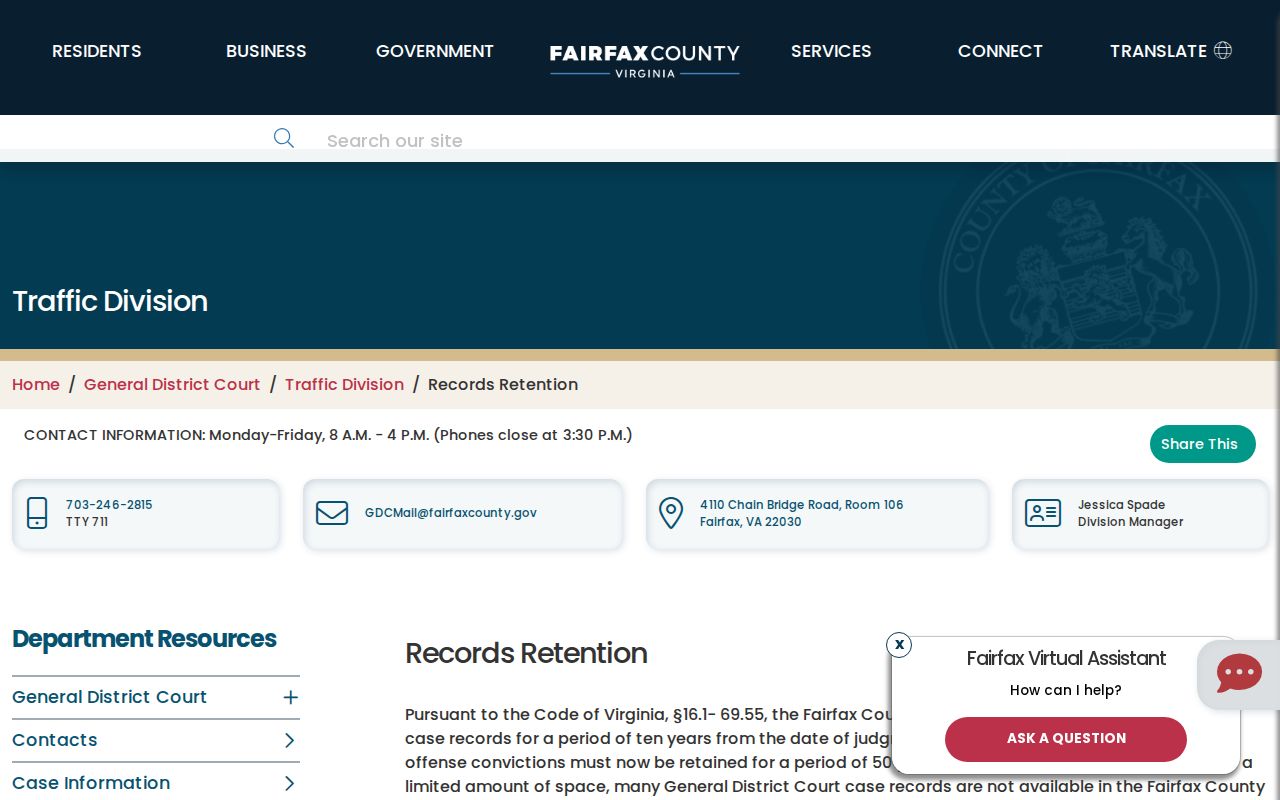
Court records are valuable when the rolling jail feed does not exist. Fairfax General District Court handles misdemeanors and felony preliminary matters. Its criminal records can show bond orders, dispositions, sentences, active and suspended time, time counted toward a sentence, and probation terms. General District Court records are generally retained for ten years from judgment or conviction, with a longer period for specified sexual-offense convictions. About three years are kept onsite, while older available files may require Archives retrieval.
The official Fairfax GDC records page documents that retrieval path, and the matching image preserves the official source used for the three-day records check.
The court file can explain why detention authority changed. It usually does not give the minute the Fairfax ADC completed identity checks, sentence review, warrant checks, property processing, and departure.
Fairfax Circuit eCaseSearch covers nonconfidential felony and appealed-misdemeanor information. The clerk's criminal case information explains copy access, while its file review request supports older record inspection. Read the most recent entry in every related case, since dismissal in one case does not cancel another hold.
The Fairfax General District Court Criminal Division is the local source for misdemeanors and felony preliminary matters. Its release or bond order supplies legal context, but the Sheriff transaction remains the source for the completed ADC exit time.
Fairfax 72 Hour Feed Substitute
Fairfax County's documented substitute for the absent 72-hour feed is the ADC phone branch plus a narrow Sheriff records request. Use the Fairfax Sheriff FOIA page and ask for existing correctional-status and release-date fields. Add the release transaction or related shift-log entry, recorded release type or authority, and the destination if the person transferred. Supply enough identity and booking detail to distinguish the record.
Virginia FOIA ordinarily calls for a response within five working days, with a possible additional period when timely production is not practical. Actual-cost charges may apply. A request for three named dates and one booking is more focused than a request for a newly compiled rolling list. Ask for electronic records in an existing format and a cost estimate before charges are incurred.
This official substitute also has limits. A disclosed release date concerns one ADC custody episode. It does not by itself prove that all court duties, probation, parole, or another agency's custody ended. The destination record completes the chain.
If a Sheriff response gives a date but omits the event type, request the existing release card, transfer sheet, code definition, or named shift-log entry. Staff need not form a new conclusion. When a cost estimate is high, narrow the booking dates, omit unrelated correspondence, and ask first for the public status and release-date fields. That keeps the three-day inquiry tied to the person and event at issue.
Fairfax Release Alerts and Transfers
Virginia Jail VINE is the local alert layer. It can send notices for release, transfer, death, escape, and other custody changes by available phone, email, text, TTY, or in-app channels. A VINE event is not a historical three-day list. It also needs interpretation. Official Virginia material warns that a local notice can reflect movement to VADOC or another jail.
If the Fairfax ADC identifies a transfer, search the receiving system. VADOC covers state custody and active community supervision, and its public locator updates daily rather than in real time. BOP covers federal prisoners after entry into that system. ICE's locator concerns a separate federal custody layer and has limited recent-release coverage. A miss in any one system may reflect lag, spelling, an alias, a completed record outside the locator's scope, or the wrong custodian.
- Release
- The recorded local custody episode ended; supervision or another legal duty may still remain.
- Transfer
- Physical custody moved to another authorized agency rather than to the community.
- Discharge
- The stated sentence or supervision duty ended, as defined by the controlling agency record.
- Work release
- The person may work outside secure confinement while remaining in Sheriff custody or under court-ordered control.
For a single name across all available Fairfax paths, use the Fairfax County released-inmate lookup. It reconciles the Sheriff, court, state, federal, and notification layers without treating a roster miss as proof.
Alternative Incarceration Branch status also needs care. Work Release, Community Labor Force placement, and Electronic Incarceration are forms of confinement or court control. Time spent outside secure confinement does not establish final discharge. Confirm program completion through the Sheriff status record and the controlling court order.
Note: Preserve whether an alert says release, transfer, death, or escape; those events are not interchangeable.