
Fairfax Parole and Probation
Parole and probation both place a person in the community under rules, but their legal sources differ. The Virginia Parole Board decides parole. The Virginia Department of Corrections, or VADOC, administers state community supervision. Probation is often imposed by a court as part of the sentence. It may start after active incarceration ends, or a court may suspend part of a term and require probation instead. Fairfax General District Court Services also handles certain local probation cases and supervised pretrial release. That program is distinct from VADOC supervision.
Virginia sharply limited ordinary discretionary parole for felony offenses committed on or after January 1, 1995. Virginia Code § 53.1-165.1 contains the rule and its exceptions. A person leaving the Fairfax County Adult Detention Center should therefore not be labeled a parolee without a Board or VADOC record. Release on bond, supervised pretrial release, probation, and complete discharge are separate results.
A state parole decision also differs from post-release supervision imposed by a modern sentence. Parole depends on statutory eligibility and a Board action. Post-release supervision or probation can begin because the court's sentence requires it. The words used in casual conversation may overlap, but the signed order and agency record settle the legal type. That distinction affects which office holds the record, which conditions apply, and what document proves the supervision has ended.
| Feature | Parole | Probation |
|---|---|---|
| Authority | Virginia Parole Board grant under applicable law | Court order and sentence |
| Usual timing | After part of an eligible prison term | Instead of or after active jail or prison time |
| Fairfax verification | Board report, VADOC locator, release papers, District 29 | Sentencing order, VADOC locator, or Fairfax Court Services record |
| End point | Formal completion or discharge from parole | Court or supervising agency confirms completion or discharge |
- Parole
- Conditional community release from an eligible prison term before the sentence framework fully ends.
- Probation
- Court-ordered supervision in the community, sometimes tied to suspended jail or prison time.
- Post-release supervision
- A set period of state supervision that begins after active incarceration.
- Discharge
- The formal end of the supervision obligation, not merely the end of physical confinement.
Verify Fairfax Post-Release Supervision
Start with the source tied to the sentence. The VADOC Inmate and Supervisee Locator covers people who are currently in state custody or under VADOC supervision. It accepts a first and last name or a seven-digit DOC ID, with optional filters. The locator updates daily and warns that entries can be inaccurate or stale. It is not proven to be a permanent archive of people who have fully discharged.
A Fairfax court record supplies the legal context. It can show the sentence, suspended time, probation term, violations, and later orders. The Board's public reports apply only to parole decisions. A grant documents approval, not the exact time the person left a facility. Match the name and identifier across records before drawing a conclusion.
Virginia's official sources answer separate parts of the inquiry. The VADOC supervision types describe the agency framework, while Virginia Code § 53.1-151 supplies parole-eligibility rules for qualifying cases. The Parole Board posts its public meeting calendar and dated reports, including the July 2026 decisions. A meeting or grant still requires VADOC release proof.
Fairfax General District Court Services handles certain local supervision functions, while Circuit Court maintains felony cases and appealed lower-court matters. The correct docket may therefore depend on how the case moved through court. Search all known case numbers tied to the custody episode. A probation term can be amended, extended, revoked, or terminated by a later order, so the newest signed entry carries more weight than an older case summary.
- Read the latest sentencing or supervision order. Identify parole, VADOC probation, Fairfax local probation, or supervised pretrial release.
- Search the VADOC locator by name or DOC ID. Confirm age, location, and other identifiers rather than relying on a name alone.
- If parole is possible, check the Virginia Parole Board decision reports. Keep the decision date separate from the actual release date.
- Use the displayed district or the VADOC office directory to locate Fairfax District 29. Ask only for information that the office may lawfully confirm.
- For a local case, contact the Fairfax court clerk or Court Services. Preserve the source, status label, and update date.
The broader Fairfax County released inmate search and record path helps confirm the jail release event itself. That event and the supervision start are related, but they are not the same record.
Note: A community-supervision result supports release from physical confinement, but it may not show the precise Fairfax jail exit time.
Fairfax Supervision Office Records
Fairfax District 29 serves Fairfax County, Fairfax City, Clifton, Herndon, and Vienna. The VADOC facilities and offices directory is the official source for the office and should be checked before a visit. Staffing can change, so the office rather than a personal staff name is the durable contact. No public individual check-in script was documented. A caller should not infer a person's reporting schedule from a general supervision description.
VADOC Fairfax District 29
10680 Main Street, Suite 300
Fairfax, VA 22030
703-934-0880
The official VADOC office directory shows the agency page used to locate District 29 and other supervision offices.
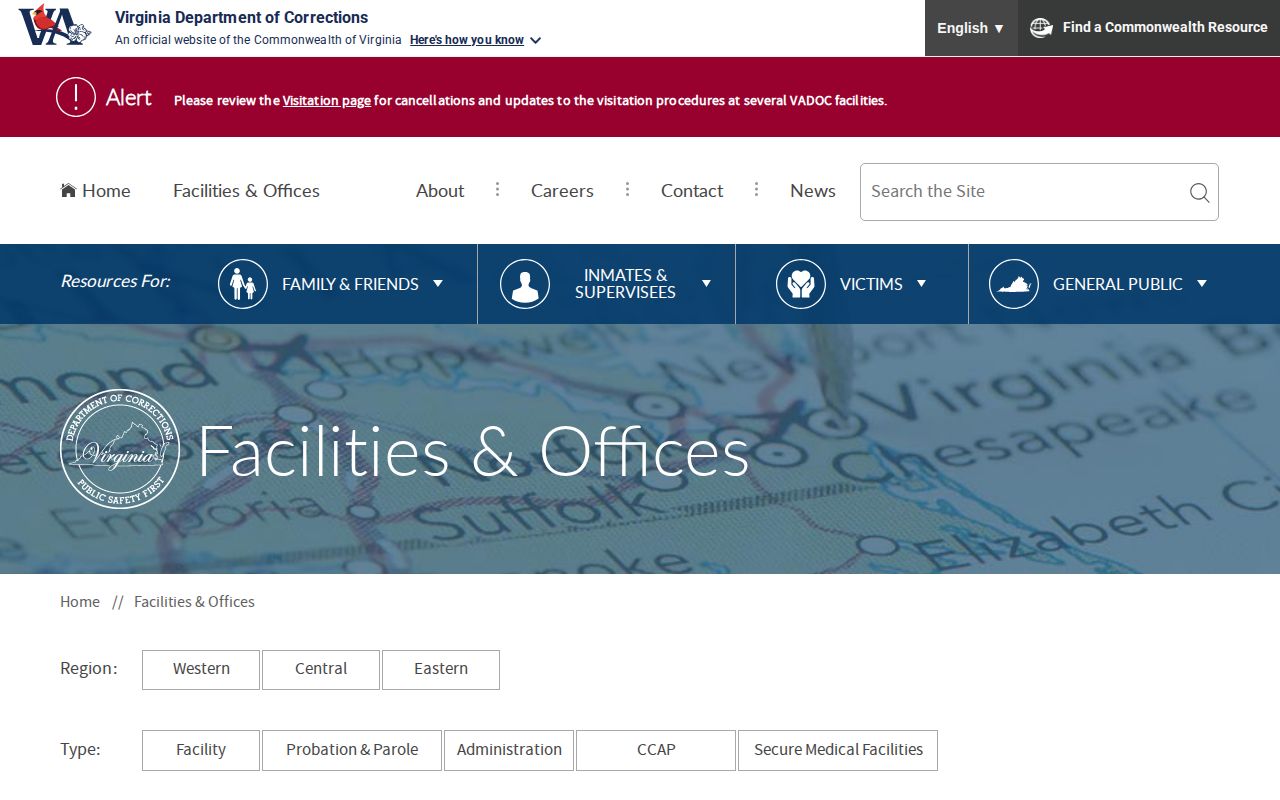
The directory view is a routing source. It does not reveal a person's private reporting terms or prove that supervision is active.
VADOC describes intensive, medium, and low supervision levels. Low-level supervision may use monthly contacts and biometric verification. Other conditions, such as GPS monitoring or a residential placement, depend on the order, law, and individual plan. The directory can confirm the district, but the operative order and supervising officer's lawful instructions define the case.
Fairfax Probation Violation Records
Supervision conditions vary. They can require reporting, travel approval, treatment, payments ordered by the court, or compliance with location rules. A suspected violation is not the same as a final violation finding. The file may include an officer report, a capias, a Board warrant, a hearing, and a later order. A capias is a court command to take a named person into custody. An absconder is someone the supervising authority alleges has stopped reporting or cannot be located as required.
The VADOC Most Wanted page is selective. It explains PB-15 officer warrants, court capiases, and Parole Board warrants, and it may mark a listed person as captured. A missing name does not prove that no warrant exists. District 29, the relevant court, and law enforcement are the proper sources for an authoritative status. Members of the public should not try to apprehend anyone.
Virginia Jail VINE concerns local custody changes, not every probation event. Likewise, a VADOC location change may reflect a new supervision placement or return to custody. Keep each label intact. If a status conflicts with a court entry, compare the date and the agency that created each record before deciding which event occurred first.
A warrant can change the next step without changing the prior release record. It may lead to arrest, a violation hearing, or return to custody, but each event needs its own proof. A Board warrant concerns parole authority. A capias comes from a court. A PB-15 officer warrant is another VADOC process identified by the agency. Avoid collapsing all three into a generic “wanted” label, since the issuing authority and review path differ.
Note: Most Wanted is a selected public list, so absence never proves that Fairfax probation or parole remains in good standing.
Fairfax Supervision Discharge Records
Physical release and discharge are different milestones. A person can leave the ADC or a VADOC facility and begin community supervision that lasts beyond the incarceration term. Supervision ends when the responsible authority records completion, discharge, termination, or another lawful outcome. Simply failing to find the person in a current locator does not establish that end point.
For probation, review the sentencing order and later docket entries for completion, early termination, a violation, or revocation. For parole, use the Board decision record, VADOC supervision record, and any release or discharge documents. VADOC's public locator can be useful while supervision is active. Its absence after full discharge may require a focused records request because the locator is not documented as a permanent historical index.
Fairfax Court Services is a separate local track. It can administer supervised pretrial release and local probation for eligible cases. A pretrial supervision end may follow a new court order or case disposition rather than a VADOC discharge. Use the agency named in the order. That small step prevents a state probation record from being mistaken for a local pretrial case.
When no current online result appears, request an existing discharge or completion record from the named custodian. Give the full legal name, date of birth, DOC or court identifier, and approximate supervision dates. Ask for the status and effective date already kept by the agency. If the office does not hold the record, ask whether it can identify the proper custodian. A negative search page alone should never substitute for that response.
Fairfax Release Reentry Support
Fairfax release planning can begin before a person reaches community supervision. Sheriff SOP 225 calls for OAR assessment of people nearing community release, generally within sixty days and, for some case-management work, up to 120 days. OAR can help assess needs and coordinate a plan. The policy documents a process, not a promise that every person will receive each service.
A separate Sheriff and Community Services Board partnership supports continuity for medication-assisted treatment. The Fairfax treatment continuity program may provide bridge medication and, in some cases, direct transport to continuing care. Eligibility and current availability must be confirmed with the program. These services do not replace supervision conditions, but they can help a released person meet health needs while starting parole, probation, or another court-ordered plan.
Release planning also does not identify the supervising agency. The court order, VADOC locator, and District 29 record still control that question. Treat reentry support and legal supervision as linked but separate tracks.