
Fairfax Projected Versus Actual Release
A projected date is an administrative forecast based on the sentence and information known at the time. VADOC uses the exact phrase “projected release date” in Operating Procedure 010.3 and permits staff to confirm it at inquiry. The forecast may assume a current earning class and may not yet reflect a new warrant, detainer, disciplinary action, or court order. An actual release date records when the custodian completed the transaction. For Fairfax County Adult Detention Center cases, the Sheriff's correctional-status and release-date fields are stronger proof of the final local event.
A pretrial detainee usually has no fixed projected date. Bond may be granted, but release still depends on satisfying its terms and clearing every other hold. A dismissal may end one charge while another case continues to hold the person. Even a sentenced inmate remains subject to final checks. The court supplies legal authority; the custodian documents the physical exit or transfer.
Three dates may appear in one Fairfax matter without a true conflict. The court can enter an order on one day. The jail can finish release processing later, sometimes after midnight. A notification system can transmit the change after the agency posts it. Preserve the label and timestamp from each source. The order date explains authority, the projected date states the forecast, and the release transaction records the completed custody event.
- Projected release date
- The agency's current estimate after applying sentence inputs and credit rules.
- Actual release date
- The date the custodian records the release or transfer transaction.
- Detainer
- A notice that another authority may have a legal claim to custody.
- Jail credit
- Time served before or during sentencing that the court or computing authority applies to the term.
Find Fairfax Projected Release Dates
The correct path depends on who computes the term. The VADOC Inmate and Supervisee Locator covers people currently in state custody or supervision. Search by first and last name or a seven-digit DOC ID. The public result was protected during research, so no exact public date-field label should be assumed. VADOC's policy independently confirms that staff can provide a projected date at inquiry.
For a local Fairfax sentence, use the ADC phone instructions and call 703-246-2100, press 4, then choose the branch for inmate information or bonds, release dates, and court dates. Pair that response with the sentencing order and jail-credit entry. The Fairfax County release record path explains how to seek the final local transaction once the person leaves.
For state calculations that need more detail, VADOC directs questions to its Correspondence Unit and Court and Legal Section at P.O. Box 26963, 6900 Atmore Drive, Richmond, VA 23261, with the agency main number at 804-674-3000. Ask for confirmation of the existing projected release date and the record that supports it. A focused inquiry is more reliable than trying to reconstruct a term without the agency's full sentence history.
- Identify the present custodian. Distinguish the Fairfax ADC, VADOC, another jail, federal custody, and community supervision.
- Read the sentencing order. Note active time, suspended time, offense date, mandatory terms, and court-awarded jail credit.
- For state custody, search VADOC and then contact its Correspondence Unit or Court and Legal Section for the current computation.
- For local custody, ask the ADC which authority calculated the date and request the existing time-computation record.
- Before relying on the forecast, check for later court orders, discipline, warrants, detainers, or a transfer.
- After the event, obtain the actual release or transfer record from the agency that held custody.
Note: An ADC inmate number and a seven-digit VADOC ID are different identifiers and should not be used interchangeably.
Virginia Earned Release Credits
Virginia uses more than one credit system. Older Good Conduct Allowance sentences generally concern felonies committed before January 1, 1995 and certain older misdemeanors. VADOC describes earning classes that range from zero to thirty credit days for each thirty days served. For qualifying totals longer than twelve months, the agency may also compute parole eligibility and mandatory-parole dates. The offense date and sentence law matter, so an older case cannot be calculated with only the modern formula.
For the modern felony regime, Virginia Code § 53.1-202.2 defines eligibility. One earned credit removes one day from the term. § 53.1-202.3 sets the rates. Listed serious offenses in subsection A have a maximum rate of 4.5 credits for each thirty days served. Other eligible subsection-B offenses can earn fifteen, 7.5, 3.5, or zero days per thirty, based on the assigned level. Classification is reviewed at least once per year.
The common “serve 85 percent” phrase is not exact. At 4.5 credits per thirty days served, the arithmetic is about 86.96 percent of a credit-adjusted term when the person earns the maximum and nothing else changes. Other rates, mandatory minimums, excluded offenses, jail credit, and discipline can yield a different date. No one should calculate a named person's Fairfax projected release from sentence length and a headline percentage alone.
Credit level is only one part of the calculation. The active sentence can differ from the full term because a court may suspend part of it. An amended order can change the inputs. VADOC must also account for pre-reception jail time, sentence type and length, earning class, disciplinary events, and any sentence that has not yet been calculated. The final checks in Operating Procedure 050.3 are why the official computation sheet matters.
The VADOC Time Computation page is the official overview of the inputs used for a state sentence.
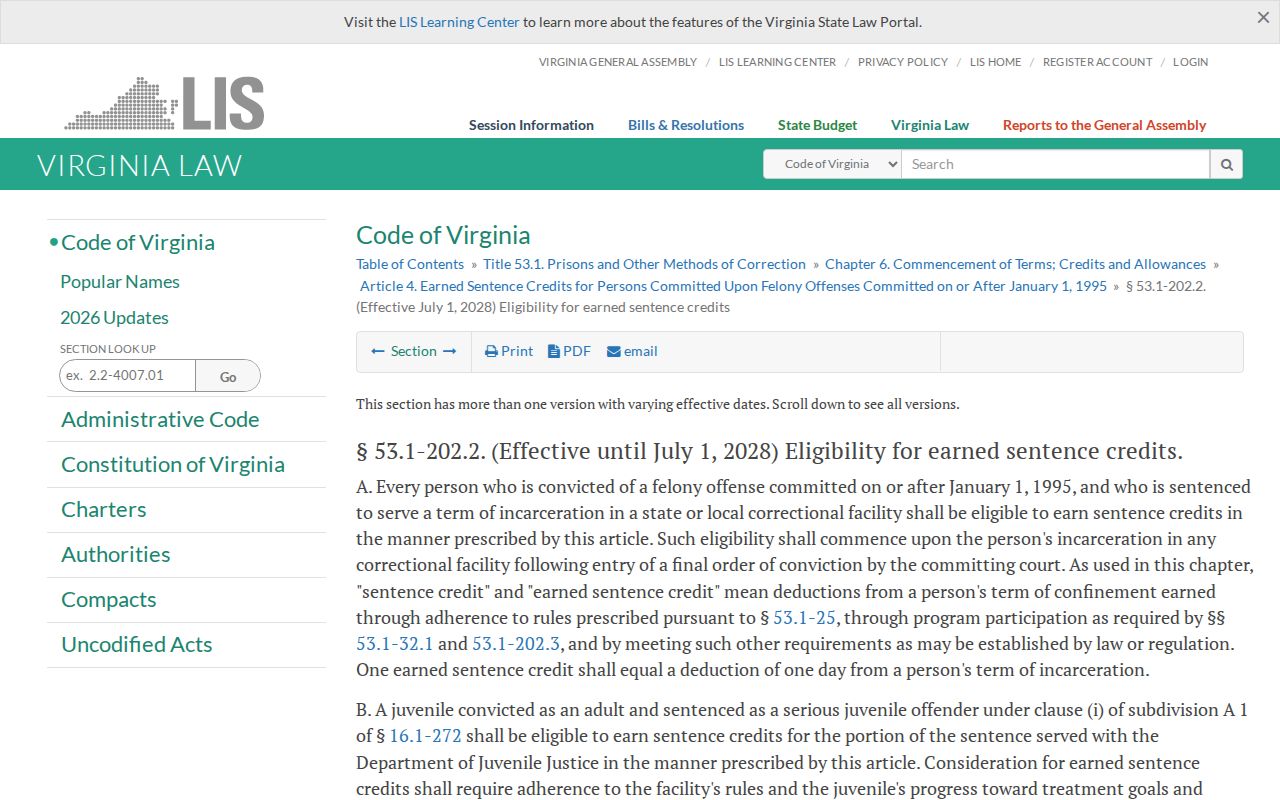
The statute view helps identify eligibility, but the complete calculation still requires the actual order, offense, credit class, and agency record.
Fairfax Release Date Changes
VADOC identifies pre-reception jail time, active sentence length, sentence type, earning class, discipline, and later sentence events as computation inputs. Its final-release controls also require checks for warrants, detainers, continued-custody orders, uncalculated sentences, and discipline that affects the date. Fairfax Sheriff SOP 526 documents local booking checks before release. A date can move even when the original sentence remains the same.
| Factor | Possible effect | Record to check |
|---|---|---|
| Jail credit correction | Adds or removes credited days | Court order and computation sheet |
| Earning-class change | Changes the rate of future credit | VADOC time computation record |
| Disciplinary offense | Can reduce or remove earned credit | Discipline and recalculation record |
| New court order | Can amend active time or require continued custody | Latest signed order |
| Warrant or detainer | May block community release or cause transfer | Final custody check and receiving-agency record |
| Parole action | May authorize conditional release in an eligible case | Board decision plus VADOC release record |
A transfer date is not a community-release date. If the ADC hands a person to VADOC, a federal officer, another jurisdiction, or an authority acting under valid judicial process, Fairfax physical custody ends while confinement continues elsewhere. The receiving system then becomes the main source for the next projected date.
Parole needs special care. A Virginia Parole Board grant is permission for conditional release in an eligible case, but the certification date and facility departure can differ. A denial can leave the computed sentence path in place. Neither decision should be treated as the final movement record. Confirm execution with VADOC release papers or a change to community supervision.
Confirm Fairfax Actual Release
For a VADOC facility release, the agency says the person is discharged or leaves on parole and receives a notification-of-release letter. Staff review the Order of Release, Conditions of Probation, or Conditions of Parole, and the person and a witness sign and date the documents. VADOC states that release occurs by 11:59 p.m. on the release date, weather permitting. Those documents are stronger proof than a name disappearing from a locator.
For a Fairfax ADC release, ask for correctional status, release date and time, recorded release type, and any receiving agency. A court docket can explain the authority, but it may show the order date rather than the out-processing time. Virginia Jail VINE can send a custody-change alert. Its alert may also describe a transfer, so use the Fairfax VINELink inmate search together with ADC or VADOC confirmation.
Keep the exact words from each source. “Projected,” “released,” “transferred,” “community supervision,” and “discharged” describe different stages. When two dates conflict, compare who created each date and what event it labels. Overnight processing can also place the court order and jail transaction on adjacent calendar dates.
For future notice of a local custody change, Virginia Jail VINE is the relevant alert layer. For eligible state crime victims, VADOC uses the separate NAAVI system and may send advance and actual release information. Registration in local VINE does not move into NAAVI. A public locator search also does not create eligibility for restricted state notifications. Choose the system that matches the custodian and purpose.
Fairfax Local Release Calculations
Local jail credits follow a distinct path. Virginia Code § 53.1-116 requires local jailers to keep commitment and prisoner records and maintain a written earned-credit policy. Qualifying misdemeanor sentences of twelve months or less may earn one day for each day served when the person follows the rules, unless a mandatory minimum applies. Other credit categories and programs have their own conditions.
A felony sentence does not gain a more generous rate merely because the person remains in a local jail. For qualifying felony conduct after January 1, 1995, the Article 4 earned-credit limits still apply. That is why the first Fairfax question is who computed the term: local jail staff, VADOC, or both at different stages. A state-responsible person may stay physically at the ADC while VADOC calculates time.
Ask for the time-computation record rather than requesting a new calculation. Compare it with the signed sentence, the court's jail-credit award, and any later order. State-record requests use the VADOC FOIA process, while the agency's facility release page describes final documents. Then obtain the final Sheriff transaction. This chain preserves the difference between a forecast, its inputs, and the event that actually ended Fairfax custody.
If the computation and court docket seem to disagree, do not replace one label with the other. Ask whether the court date is a disposition, sentencing, or amended-order date, and whether the agency date is projected or actual. A jail may record the completed transaction after the court acted. VADOC may also update a forecast after new credit or hold information arrives. For durable proof, use the Fairfax Sheriff FOIA channel to request the existing local transaction.
Note: Fairfax's scheduled release workflow does not turn every computed date into a fixed release hour or guaranteed community departure.